Di tutto un po’ | Fausta Squatriti
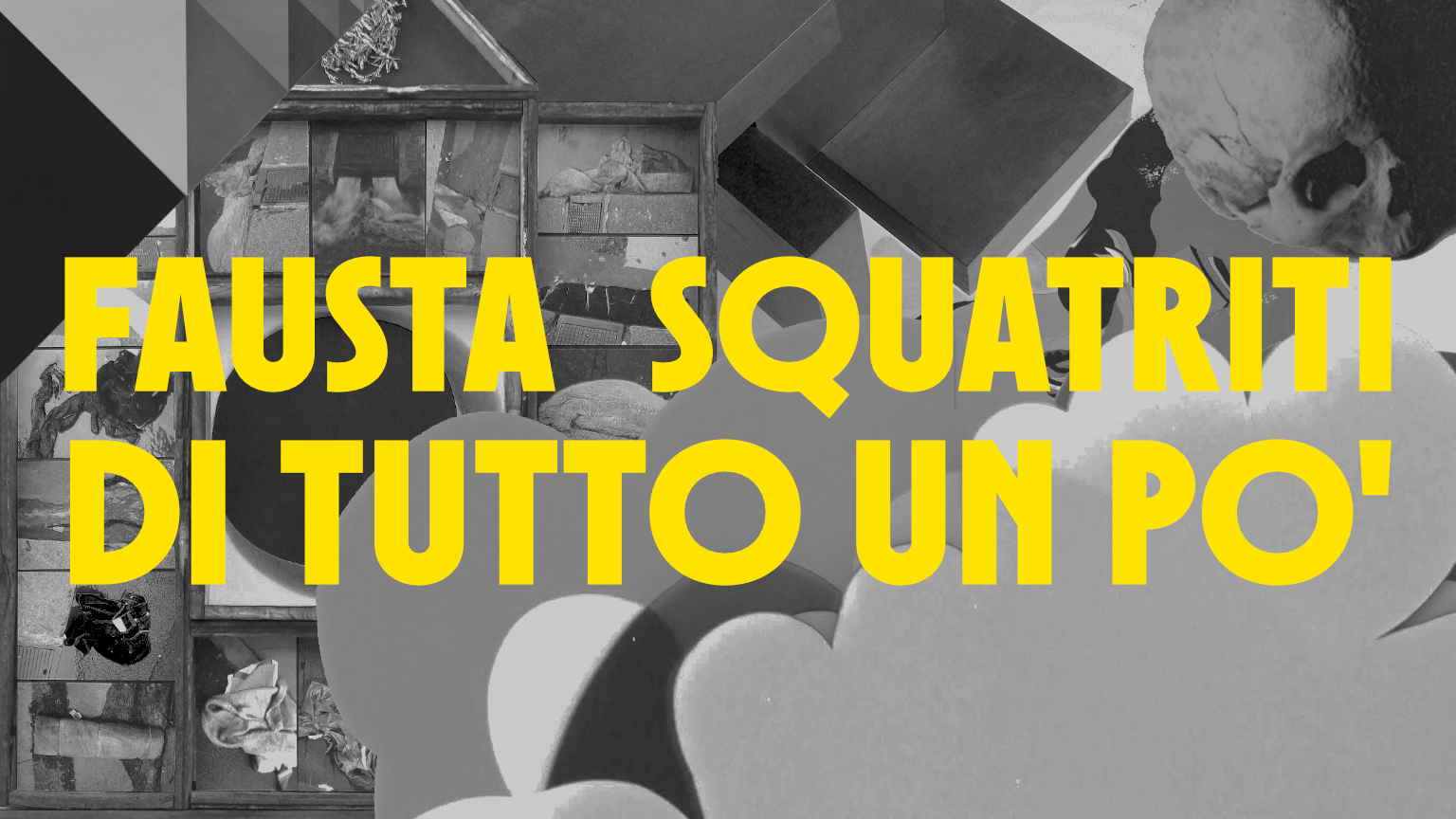
Nuova Galleria Morone, in collaboration with the Archivio Fausta Squatriti, presents Di tutto un po’, an exhibition dedicated to Fausta Squatriti, tracing the multiplicity and diversity of her artistic research through a selection of works. Almost ten years after the exhibition season of February 2017, when Milan celebrated Squatriti’s work with three simultaneous exhibitions at Gallerie d’Italia, Triennale Milano and Nuova Galleria Morone, each focusing on a specific period of her production, the gallery returns to engage with the full breadth of her artistic practice.
Di tutto un po’ takes shape, in fact, as a kind of bringing together of those exhibition experiences, while moving beyond them to embrace the different moments, languages and thematic strands of Squatriti’s production, without following a chronological sequence or a specific periodisation. The title takes its name from a folder found on the artist’s computer, which contained works belonging to different periods: a simple, almost ironic heading that aptly conveys the heterogeneous yet profoundly coherent nature of an artistic practice developed over more than sixty years through painting, sculpture, printmaking, poetry and writing.
Rather than seeking to provide an exhaustive retrospective of an extensive and multifaceted body of work spanning more than six decades, the exhibition aims to explore the creative mechanisms that shaped and sustained the practice of an artist with a distinctive artistic identity.
At the heart of this practice lies a continuous questioning of the formal and visual elements that Squatriti chose to investigate at different stages of her career. She did not simply explore a language or consolidate the results she had achieved; rather, she constantly questioned their underlying premises, testing their possibilities and limitations. Each body of work seems to fulfil its purpose precisely when it gives rise to new questions: at that point, the artist moves elsewhere, turning towards different visual problems, structures and modes of expression.
The transition from one field to another is therefore not driven by a linear progression, but by the need to identify a new area of inquiry each time, in a process that resists definitive solutions and predetermined formulas. What emerges is an artistic trajectory in which the plurality of languages she explored — from the visual arts to poetry, from narrative writing to critical essays — does not amount to a mere succession of experiences, but rather reflects a constant critical attitude: questioning what has already been established in order to open up new possibilities for investigation.